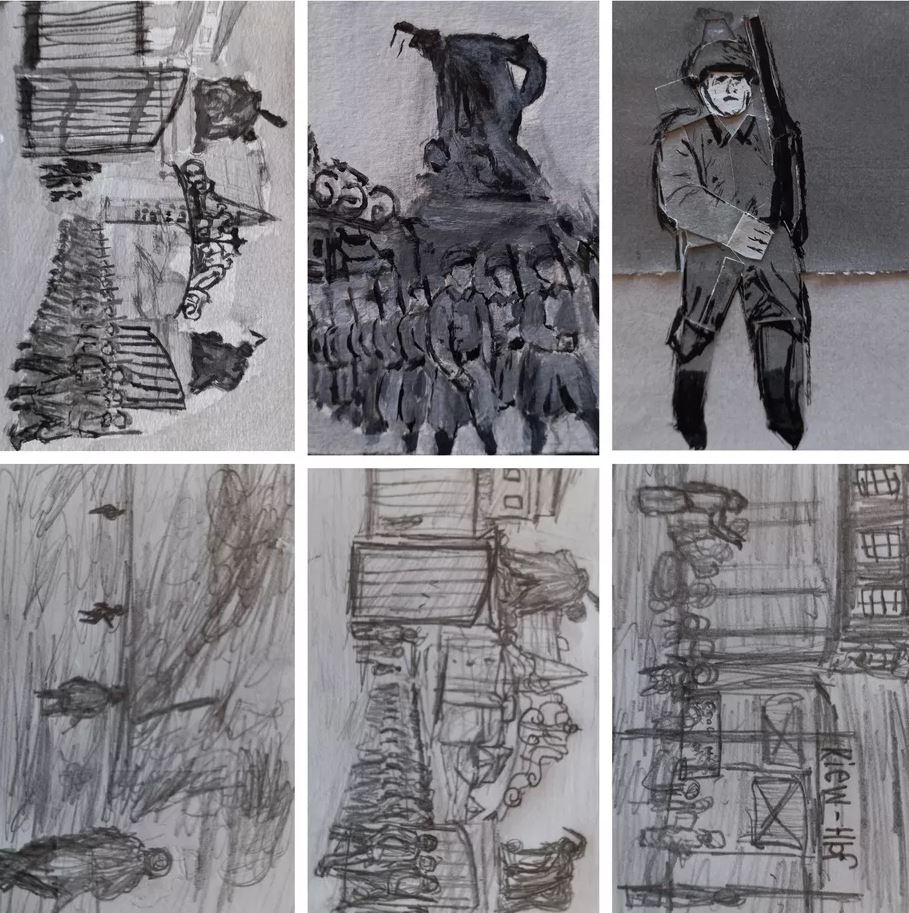
In the first term of 2023, Belinda Selikowitz, the educational Co-ordinator of the South African Jewish Museum invited the Herzlia High School Art department to engage in an interdisciplinary, cross-content partnership with History teacher, Liz Weide from West Forsyth High School, Clemmons, NC. The idea behind the project was to use the Centropa archive to explore the lives of Ukrainian Jews. The archive’s mandate is to preserve Jewish History and bring it to Life. We chose our Grade 10 Art pupils to engage with American Grade 11 History pupils.
From our perspective, the project, and specifically the opportunity to work with History pupils, offered multiple possibilities:
- Art by its very nature relies heavily on History. We study the historical context in which artworks were created to try to understand the philosophical and practical considerations of the artists who produced them. However, we are not History scholars, and as a result, we do not have the knowledge to engage in as much depth as we would like to, nor the skills to engage with the Historical archives which are rich in resources. We hoped that we could learn from the History pupils and draw on their skills and knowledge in this area.
- The project offered an opportunity for integration with Jewish Life and Learning, a key focus area in our school as we continue to embed Jewish culture into all spheres of school life.
- It allowed us an opportunity to meet and work with other pupils in another country, and interestingly, this is not a Jewish school that we partnered with.
- The project would allow us to reflect on the practice of our specific subject by exploring the differences between, for example, evidence in History as compared to interpretation in Art.
While an interdisciplinary project is exciting, bringing two subjects together can cause unintended difficulties since the two subjects have different conceptual pathways, different demands or desired outcomes and often require work at a different pace. There were challenges and compromises in the development of the project. The teachers from different continents worked together to preserve the integrity of their subjects while looking for opportunities for exchange and learning something by thinking differently.
The project had two strands. Each started with a platform, called Padlet, where pupils from each school introduced themselves with photographs and short biographies. The two strands of the project were as follows:
The first part of the project was titled:
Part 1. Past Ukraine
- The West Forsyth High pupils shared information about an event in Ukraine and its impact on the Jews in the 20th Century that was shared with the Herzlia pupils as PowerPoint presentations.
- The Art pupils read the PowerPoint, selected a particular topic, and responded with a series of small and exploratory works in ink, paint and collage to the subject matter provided.
- The Art pupils shared their explorations with History pupils.
- The History pupils wrote letters to the Art pupils, sharing their comments on the work provided. There were many poignant responses, and I have selected a few extracts to give insight into the exchange:
“I love how you can see the struggle on his face, it really represents the struggle that Jews went through during this time. I think that the addition of a background was a great idea because it allows him to stand out more than if it was a plain white background”
“You have done a good job of showing the Nazi soldiers and how intimidating they were in their numbers”
In addition to the insights provided on the work itself, the pupils were also really supportive of one another, and we read comments like, “I’m not an artist and I wish I could draw as good as you […] Eyes were always the hardest for me to do in art class and you definitely have the eyes down”
The second part of the project that brought pupils into the present was titled:
Part 2. Present Ukraine
- The West Forsyth High pupils researched present-day Ukraine and examined the status of the war, refugees, economic crisis, education, healthcare, housing efforts and global aid efforts. They shared their findings and provided source visual material in PowerPoint presentations.
- The Herzlia pupils selected a student presentation to respond to. They began with letters to the History pupils to outline the key ideas that interested them and what images they found poignant for further development. They also outlined how they intended to translate the information into art, with a focus on how the subject matter and material or technique of the artwork could be used to contribute to the key ideas they had identified in the PowerPoint presentations.
In their letters, we see their learning about present-day Ukraine:
“You have shown me that Ukraine had social and economic issues before the war and Covid-19. The reason fertiliser is so expensive in Ukraine is because of the economy changing due to Covid. Grain production had been slowed due to climate change prior to the war between Ukraine and Russia. These facts are making me think about the war from another perspective, not all of Ukraine’s problems stem from Russia alone”
“I learned that there are so many poor people that are suffering and fighting for their lives. They are all so innocent and have done nothing wrong. I’m interested in how people survive and stay healthy without being hurt or killed.”
We can see that the activity of writing the letters has helped them to plan and think about media:
“I have chosen to do acrylic paint as a medium to translate the photos into artworks as this medium can be layered to show the complex and meaningful tragic events that are taking place. In the images I chose, you can see the fear in their faces very clearly and it shows a lot of emotion”
“The picture of the destroyed home really shows the true devastation of the war. I am going to illustrate the picture of the destroyed home and a picture of Oleksandra. I am going to work with ink as this will allow me to blur and show the ‘smoky’ feel of the war-torn area.”
Their insights in the letters were telling of positive experiences that stemmed from the exchange. One Art student wrote: “It was very nice to have been sent work from pupils instead of teachers because we can learn from other pupils.”
The Art pupils went on to make the artworks, which were shared with the History pupils. You can see their production here:
Part 1 of the project: Click here
Part 2 of the project: Click here
After exams, we will do a reflective task with our pupils to engage with the question: “What is the difference between a historical source used as evidence and an artistic representation of the same scene?”
From our side as teachers, it has been a very rich opportunity to work with a highly skilled department in another country and learn as much about the content (History) as their professionalism, collegiality and investment in student learning. We will also reflect on the areas of difficulty to consider how we can make the project better with more careful pacing and opportunities for deep reflection if given another opportunity in the future.
LAUREN PALTE
Head of Art, Herzlia High School